
One system. Many perspectives. Real impact.
In the Multidisciplinary Systems Hub, students from different programmes build one system.

The idea
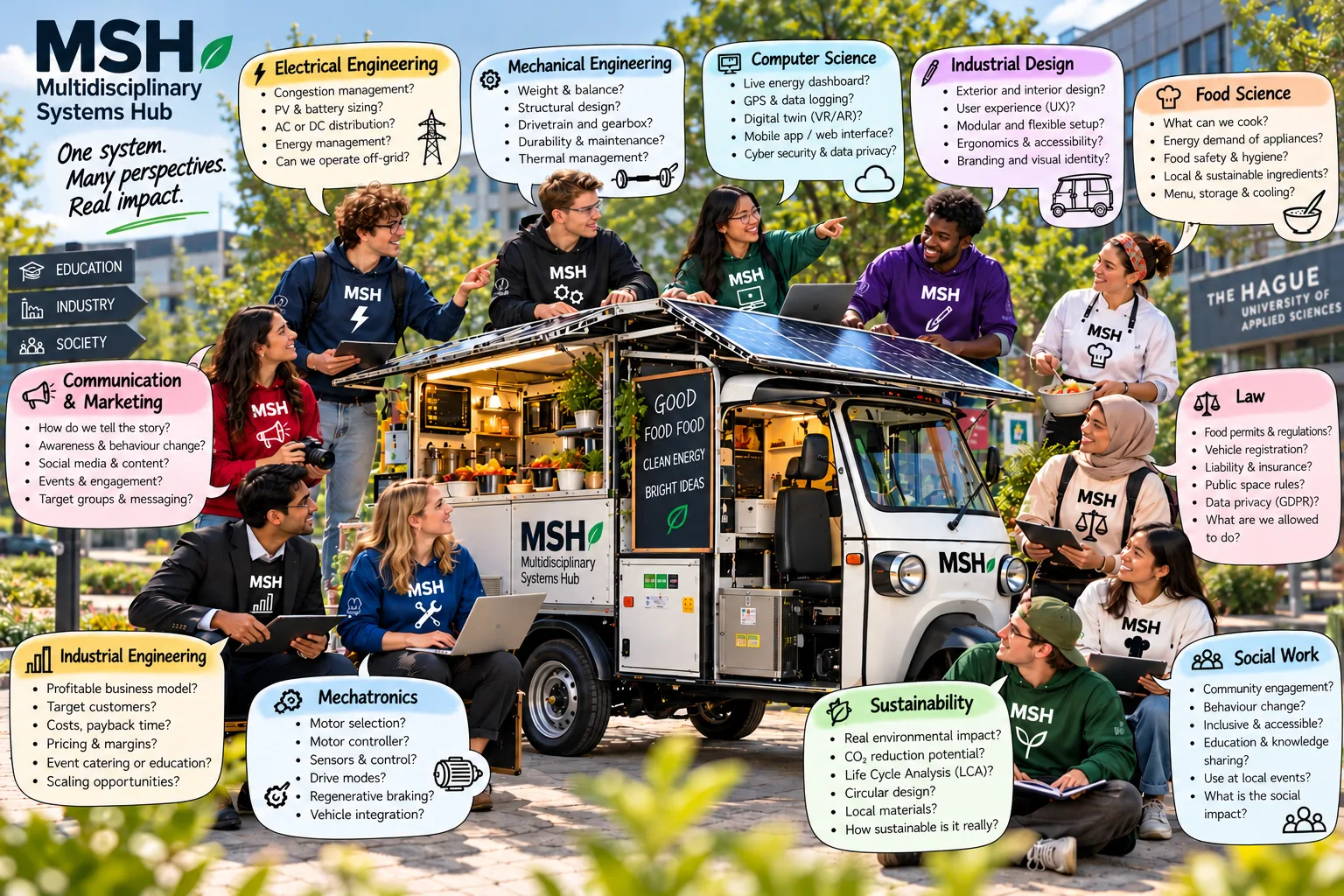
Not eleven separate projects around one TukTuk, but one system. A design choice in one discipline has consequences for the others.
That makes working across disciplines a necessity, not a line in the project description.
What you would work on
Pick your programme. The TukTuk is the example.
- Electrical Engineering
- Congestion management
- PV and battery sizing
- AC or DC distribution
- Energy management
- Can we operate off-grid?
- Mechanical Engineering
- Weight and balance
- Structural design
- Drivetrain and gearbox
- Durability and maintenance
- Thermal management
- Mechatronics
- Motor selection
- Motor controller
- Sensors and control
- Drive modes
- Regenerative braking
- Vehicle integration
- Computer Science
- Live energy dashboard
- GPS and data logging
- Digital twin (VR/AR)
- Mobile app or web interface
- Cyber security and data privacy
- Industrial Design
- Exterior and interior design
- User experience (UX)
- A modular and flexible setup
- Ergonomics and accessibility
- Branding and visual identity
- Food Science
- What can we cook, on electricity instead of wood?
- Energy demand of the appliances
- Food safety and hygiene
- Local and sustainable ingredients
- Menu, storage and cooling
- Industrial Engineering
- A profitable business model
- Target customers
- Costs and payback time
- Pricing and margins
- Event catering or education?
- Scaling up
- Law
- Food permits and regulations
- Vehicle registration
- Liability and insurance
- Rules for public space
- Data privacy (GDPR)
- What are we allowed to do?
- Social Work
- Community engagement
- Behaviour change
- Inclusive and accessible
- Sharing education and knowledge
- Use at local events
- What is the social impact?
- Communication and Marketing
- How do we tell the story?
- Awareness and behaviour change
- Social media and content
- Events and engagement
- Target groups and messaging
- Sustainability
- Real environmental impact
- CO₂ reduction potential
- Life cycle analysis (LCA)
- Circular design
- Local materials
- How sustainable is it really?
The TukTuk is the first system, not the minor
As more programmes, companies and partners join, more systems grow inside the hub. You choose the project that fits your background.
The Energiehaven Binckhorst is a second example of the same idea. In an earlier minor, Electrical Engineering students worked on how the solar panels and batteries on boats in the harbour could join a local smart grid. Besides the technical design they also took on costs and benefits, stakeholders, surveys and a scale model: work that students from other programmes can now do in MSH. See the Energiehaven project
Systems in the hub
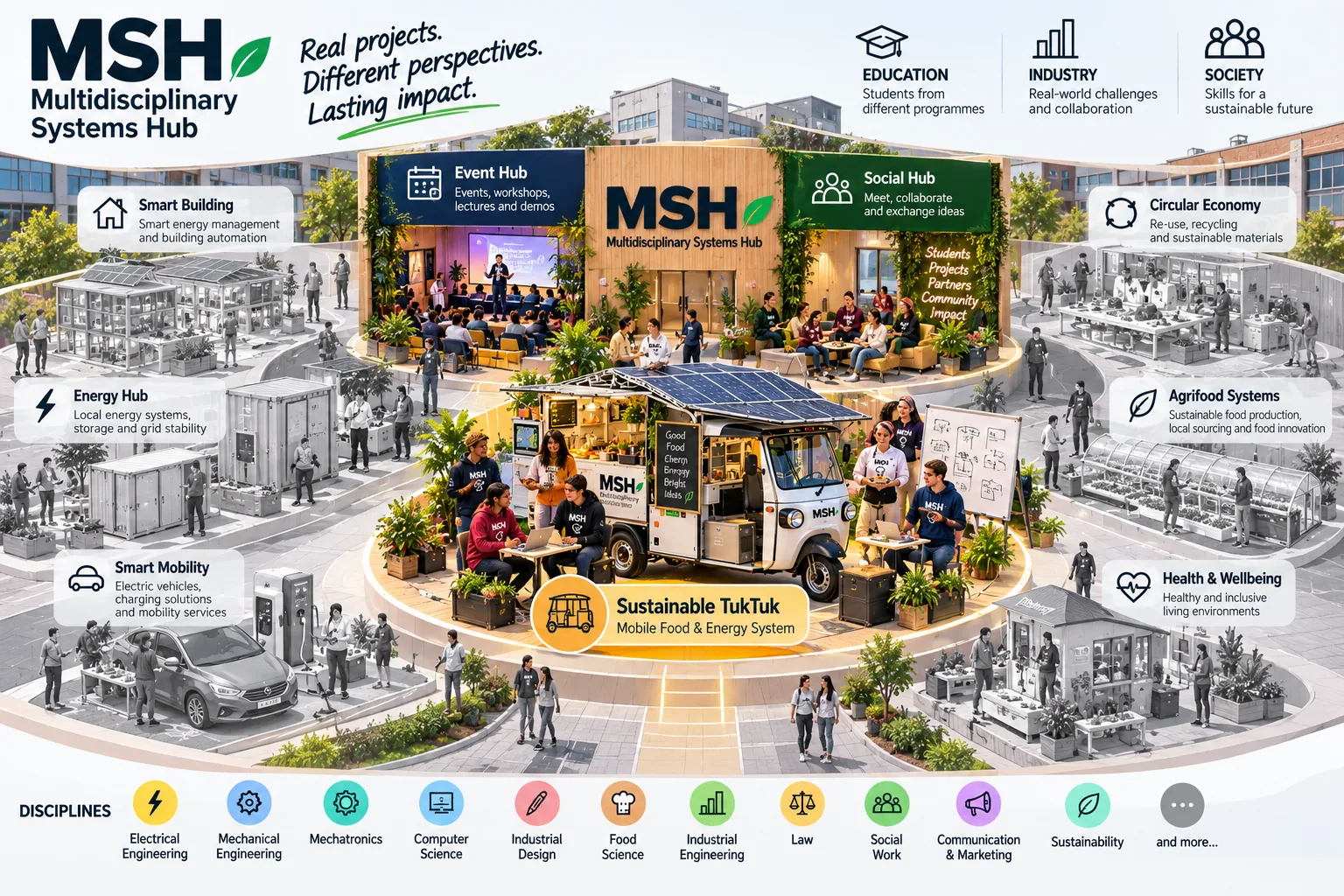
Real projects, different perspectives, lasting impact.
Sustainable TukTuk
A mobile food and energy system, the first MSH system
Energy hub
Local energy systems, storage and grid stability
Smart building
Smart energy management and building automation
Smart mobility
Electric vehicles, charging and mobility services
Circular economy
Re-use, recycling and sustainable materials
Agrifood systems
Sustainable food production, local sourcing and food innovation
Health and wellbeing
Healthy and inclusive living environments
One team, whatever you study
-
You join the hub
You bring the expertise of your own programme into one recognisable MSH team.
-
You show the work
Students contribute to PR, events, demonstrations and social media, so future students see what MSH really does.
-
You can start in either semester
The minor runs in the first and in the second semester.
Bring a challenge
Programmes, companies and other partners can bring a question to MSH, knowing it will be looked at from several disciplines at once.
- Minor
- MSH, Multidisciplinary Systems Hub
- Runs
- First and second semester
- For
- Students of any programme
- Coordinator
- Diëgo Zuidervliet, DC Power Laboratory
- Contact
- D.C.Zuidervliet@hhs.nl, with MSH Minor in the subject